What Is VJ Day – Meaning, Date and History
VJ Day represents the definitive conclusion of World War II’s Pacific Theater, marking Japan’s surrender in August 1945 after nearly four years of intense island-hopping warfare and strategic bombing campaigns. While Victory in Europe Day had already silenced the guns on one front, the announcement of Japan’s capitulation finally brought global hostilities to an end, triggering both jubilant celebrations and solemn reflection across Allied nations.
The designation “VJ Day” carries specific historical weight, commemorating not merely a military victory but the culmination of geopolitical decisions involving atomic weaponry, Soviet diplomatic intervention, and an unprecedented imperial decree. Understanding this moment requires examining the precise sequence of events that transformed an embattled empire into a nation accepting unconditional surrender aboard a battleship in Tokyo Bay.
What Does VJ Day Stand For?
VJ Day stands for “Victory over Japan Day,” terminology parallel to VE Day (Victory in Europe). The abbreviation emerged immediately in 1945 as Allied governments and newspapers sought concise language to communicate the Japanese Empire’s collapse. However, unlike VE Day’s singular date of May 8, VJ Day’s commemoration varies internationally—a complexity stemming from the gap between the Emperor’s broadcast announcing acceptance of surrender terms and the formal signing of the Instrument of Surrender.
- Dual commemoration: The United Kingdom and Japan observe August 15, while the United States officially recognizes September 2.
- Atomic catalyst: The surrender followed the destruction of Hiroshima and Nagasaki by atomic bombs dropped on August 6 and 9.
- Soviet involvement: The Soviet Union’s declaration of war on August 8 and subsequent invasion of Manchuria accelerated Japan’s strategic calculus.
- Imperial intervention: Emperor Hirohito’s unprecedented radio address directly ordered the Japanese people and military to accept Allied terms.
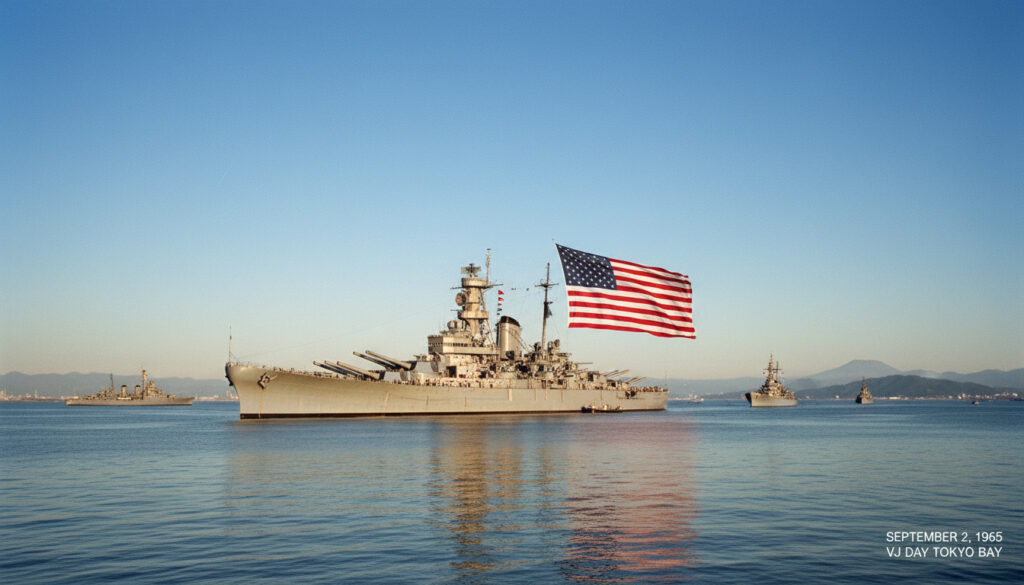
- Ceremonial formalization: General Douglas MacArthur accepted the formal Instrument of Surrender aboard the USS Missouri in Tokyo Bay.
- Legal conclusion: President Truman formally terminated hostilities on December 31, 1946, establishing the legal end of World War II.
| Event | Date | Key Figure | Outcome |
|---|---|---|---|
| Potsdam Declaration | Truman, Attlee, Chiang Kai-shek | Ultimatum for unconditional surrender | |
| Hiroshima Bombing | President Harry S. Truman | Destruction of industrial city; 80,000 immediate deaths | |
| Soviet Declaration | Soviet Foreign Minister Vyacheslav Molotov | War declared on Japan; Manchuria invasion begins | |
| Nagasaki Bombing | Major Charles Sweeney (pilot) | Second atomic destruction; 40,000 immediate deaths | |
| Imperial Council | Emperor Hirohito | Decision to accept terms despite military opposition | |
| Emperor’s Broadcast | Emperor Hirohito | Nation informed of surrender; hostilities cease | |
| Formal Surrender | General Douglas MacArthur | Instrument signed aboard USS Missouri |
When Was VJ Day?
The question of VJ Day’s precise date lacks a single answer, varying instead by national commemoration and the distinction between announcement and formal ratification. This temporal complexity reflects both the practical delays of diplomatic ceremony and the immediate psychological impact of the Emperor’s broadcast across different time zones.
August 15: The Announcement
In the United Kingdom, Japan, and Commonwealth nations including New Zealand, August 15 serves as the recognized date of Victory over Japan Day. This marks the moment when Emperor Hirohito’s voice, broadcast via radio for the first time in history, informed his subjects of the decision to accept the Potsdam Declaration’s terms. British crowds erupted in spontaneous celebration as news reached London, while Japanese citizens received the news with a mixture of confusion, despair, and relief that invasion might be averted.
September 2: The Formal Ceremony
The United States officially recognizes September 2 as VJ Day, commemorating the formal signing ceremony aboard the USS Missouri in Tokyo Bay. On this date, General Douglas MacArthur accepted Japan’s Instrument of Surrender from Foreign Minister Mamoru Shigemitsu and General Yoshijiro Umezu, witnessed by representatives from nine Allied nations. President Truman subsequently proclaimed this date as the official Victory over Japan Day for the United States, distinguishing between the cessation of fighting and the legal conclusion of war.
While most Allied powers celebrate victory in August or September 1945, President Truman formally terminated hostilities on December 31, 1946, marking the legal end of World War II under United States law and terminating wartime statutes.
What Is the Difference Between VE Day and VJ Day?
Victory in Europe Day and Victory over Japan Day represent distinct chronological and strategic milestones within the broader conflict of World War II. VE Day, celebrated in May 1945, addressed the collapse of Nazi Germany, whereas VJ Day addressed the Pacific Theater’s resolution three months later.
Chronological Sequence
VE Day occurred on May 8, 1945, following Germany’s unconditional surrender at Reims and Berlin. This European victory occurred while brutal fighting continued across the Pacific islands, with the Battle of Okinawa raging until June and casualties mounting. VJ Day thus represents the true cessation of global hostilities, occurring nearly four months after VE Day celebrations had subsided, and preventing the need for Operation Downfall, the planned Allied invasion of Japan.
Geopolitical Context
The European and Pacific theaters demanded fundamentally different military strategies. VE Day concluded a land-based campaign fought across multiple continents, while VJ Day resolved a naval-air conflict characterized by island-hopping campaigns, kamikaze attacks, and extensive submarine warfare. The Royal British Legion notes that VE Day celebrations often carried a sober quality for many service members who knew they would soon deploy to the Pacific for the final, anticipated invasion of the Japanese home islands.
What Happened on VJ Day?
The events of Victory over Japan Day unfolded through a series of unprecedented diplomatic and ceremonial actions, from imperial decrees to the formal documentation of defeat. These moments bridged the gap between wartime devastation and the uncertain peace that followed.
The Imperial Rescript
At noon on August 15, 1945, Japanese citizens gathered around radio receivers to hear a voice none had previously encountered—Emperor Hirohito delivering the Imperial Rescript on the Termination of the War. Speaking in classical Japanese that many found difficult to understand, the Emperor announced that Japan would accept the Allied powers’ terms, acknowledging the “new and most cruel bomb” and the threat to the nation’s survival. This Gyokuon-hōsō (Jewel Voice Broadcast) effectively overrode military leaders who had argued for continuing the war.
The Signing Ceremony
Seventeen days later, the formal Instrument of Surrender transformed the Emperor’s words into binding international law. Aboard the battleship USS Missouri anchored in Tokyo Bay, Japanese Foreign Minister Mamoru Shigemitsu signed at 9:04 a.m., followed by General Yoshijiro Umezu representing the Imperial General Headquarters. General Douglas MacArthur, serving as Supreme Commander for the Allied Powers, accepted the document on behalf of the United Nations, subsequently declaring: “Let us pray that peace be now restored to the world and that God will preserve it always.”
The surrender ceremony included representatives from the United States, China, United Kingdom, Soviet Union, Australia, Canada, France, the Netherlands, and New Zealand, demonstrating the truly multinational nature of the victory and the coordinated Allied effort required to defeat Japanese forces.
The atomic bombings of Hiroshima and Nagasaki resulted in immediate deaths estimated between 110,000 and 210,000 people, with subsequent radiation effects causing additional casualties in the months following VJ Day, generating ongoing historical and ethical debate.
How Did the Timeline Unfold?
The path to Japanese surrender compressed years of Pacific warfare into a final fortnight of decisive diplomatic and military actions. The sequence reveals how rapidly geopolitical fortunes reversed once the Allied powers demonstrated both destructive capacity and diplomatic unity.
- The United States, United Kingdom, and China issued the Potsdam Declaration, demanding Japan’s immediate unconditional surrender while threatening “prompt and utter destruction.” Source: National WWII Museum
- The Enola Gay dropped “Little Boy” on Hiroshima, instantly destroying the city and demonstrating atomic capability that defied conventional military defense.
- The Soviet Union declared war on Japan and invaded Manchuria, opening a second front that Japanese strategists had hoped to avoid through diplomatic neutrality.
- “Fat Man” devastated Nagasaki, while the Red Army continued its rapid advance through Japanese-occupied territory in Asia, eliminating Japan’s continental position.
- An Imperial Council accepted Allied surrender terms following the Emperor’s decisive intervention to break a deadlock among military advisors who favored continuing the fight.
- Emperor Hirohito’s radio broadcast announced the surrender to the Japanese public, effectively halting all military operations and beginning the occupation period.
- The formal Instrument of Surrender was signed aboard the USS Missouri, legally ending hostilities and establishing the framework for seven years of Allied occupation.
- President Truman issued a formal proclamation ending the state of hostilities, terminating wartime statutes and establishing the legal conclusion of World War II.
What Is Certain and What Remains Debated?
Historical consensus exists regarding the factual sequence of Japan’s surrender, yet interpretive debates continue regarding causation, necessity, and legacy. Distinguishing established chronology from ongoing historical contention helps clarify VJ Day’s significance.
Established Facts
- Japan formally surrendered aboard the USS Missouri on September 2, 1945, witnessed by Allied representatives.
- The atomic bombings of Hiroshima and Nagasaki preceded the surrender by days, not months, causing immediate and massive destruction.
- Emperor Hirohito’s broadcast on August 15 ordered Japanese forces to cease hostilities and accept occupation.
- The Soviet invasion of Manchuria began August 8, 1945, destroying the Kwantung Army within days.
- Operation Downfall, the planned invasion of Japan consisting of Operations Olympic and Coronet, was cancelled following the surrender.
Ongoing Debates
- Whether the atomic bombings were militarily necessary to prevent invasion or primarily intended to intimidate the Soviet Union.
- The precise weight of Soviet entry versus atomic attack in forcing Japan’s cabinet to surrender.
- Whether Emperor Hirohito bore personal responsibility for war crimes or acted as a moderating force against militarists.
- The ethical framework for commemorating victory achieved through the use of nuclear weapons against civilian populations.
Why Does VJ Day Matter Today?
Victory over Japan Day occupies a complex position in contemporary memory, representing both the relief of global catastrophe and the problematic origins of the nuclear age. For veterans of the Pacific Theater and their descendants, the date marks the survival of countless lives that would have been lost in the planned invasion of the Japanese home islands—Operations Olympic and Coronet—which military planners projected could have caused millions of Allied and Japanese casualties. While the end of World War II brought immense relief, the planned invasion of Japan, known as Operation Downfall, was ultimately cancelled, a decision with implications that resonate even today, much like the historical significance of the Blue Jays vs Dodgers World Series.
Modern commemorations vary in tone and emphasis. In the United States, September 2 receives official recognition, while British ceremonies focus on August 15. Japan observes August 15 as a day of mourning and reflection rather than celebration, recognizing both the end of suffering and the onset of occupation and reconstruction. Understanding these divergent perspectives—much like understanding Things You Should Have Done – Top Regrets of the Dying—requires acknowledging how historical moments carry different weights depending on one’s position within the narrative.
The legacy extends beyond commemoration into geopolitical reality. The occupation of Japan under MacArthur fostered a democratic constitutional monarchy, while the division of Korea—initially partitioned to accept Japanese surrender in the north and south—established the boundaries that would define Cold War conflict in Asia. Thus, VJ Day marks not merely an ending but the beginning of the modern Pacific order, a transition as significant as understanding What Is a Duvet vs Comforter – Key Differences in Warmth and Care might be for domestic comfort—distinct categories that serve fundamentally different purposes despite superficial similarities.
What Did Key Figures Say?
Contemporary accounts provide crucial perspectives on the emotional and strategic weight of the surrender moment.
“Let us pray that peace be now restored to the world and that God will preserve it always. These proceedings are closed.”
— General Douglas MacArthur, September 2, 1945, aboard USS Missouri
“The war situation has developed not necessarily to Japan’s advantage, while the general trends of the world have all turned against her interest.”
— Emperor Hirohito, Imperial Rescript, August 15, 1945 (translated)
What Should We Remember About VJ Day?
Victory over Japan Day signifies the definitive conclusion of humanity’s deadliest conflict, achieved through a convergence of technological innovation, military pressure, and imperial decree that spared millions from projected invasion casualties while introducing the nuclear age. Understanding these historical distinctions remains essential for contextualizing modern geopolitics, much like distinguishing between What Is a Duvet vs Comforter – Key Differences in Warmth and Care helps clarify functional categories. The day remains a testament to both the relief of war’s end and the complex moral calculations that defined the final act of World War II.
Frequently Asked Questions
What does VJ stand for in WWII?
VJ stands for “Victory over Japan,” the Allied designation for the date marking Japan’s surrender and the end of World War II’s Pacific Theater in 1945.
Is VJ Day the end of WWII?
Yes, VJ Day marks the end of World War II hostilities globally. While VE Day ended the war in Europe in May 1945, Japan’s surrender in August and September 1945 concluded the worldwide conflict.
Why does the US celebrate VJ Day on September 2?
The United States recognizes September 2 because this marks the formal signing of the Instrument of Surrender aboard the USS Missouri, whereas August 15 marks only the initial announcement of intent to surrender.
What is the difference between VJ Day and VP Day?
Australia originally used “Victory in the Pacific Day” (VP Day) for August 15, 1945, though the term VJ Day has since become predominant internationally for the same commemoration.
Did Japan surrender because of the atomic bombs?
Historical consensus suggests the atomic bombings of Hiroshima and Nagasaki, combined with the Soviet invasion of Manchuria, collectively precipitated the surrender, though historians debate the relative weight of each factor in the Emperor’s decision.
What was Operation Downfall?
Operation Downfall was the planned Allied invasion of Japan, consisting of Operation Olympic (invasion of Kyushu) and Operation Coronet (invasion of Honshu), which was cancelled following Japan’s surrender.
How many people died before VJ Day?
World War II caused an estimated 70 to 85 million deaths globally, including military personnel and civilians in both the European and Pacific theaters, making it the deadliest conflict in human history.
More related posts
 Bae Share Price UK – Live Chart, News & Analysis
 Portsmouth vs Blackburn Rovers – Match Preview, H2H & Prediction
 Police Service of Northern Ireland: PSNI Guide & Facts
 Cast of Paris Has Fallen: 2024 TV Series Actors & Crew
 How to Make Rice Pudding: Easy Stovetop and Oven Recipes
 Blair Waldorf: Character Guide, Relationships & Real Life
 Real Housewives of Beverly Hills – Season 14 Complete Guide
 When Did The Queen Die – Exact Date Time Age Facts