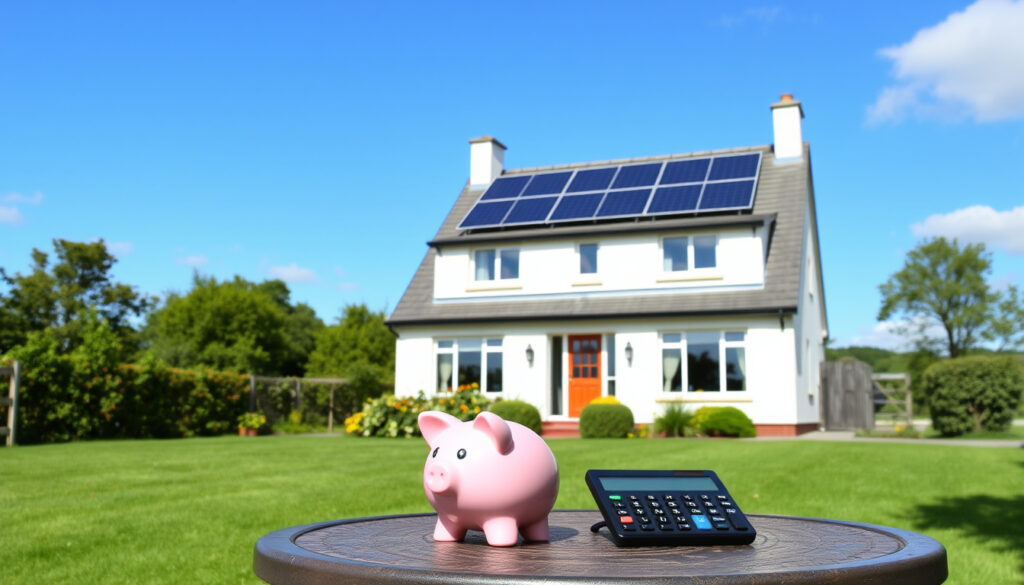
Solar Panels for Home: 2026 Ireland Cost, Grants & Savings Guide
Thinking about solar panels for your home in Ireland? You’re not alone — and the numbers are making more sense than ever. With SEAI grants of up to €1,800 and VAT cut to 0%, a typical system now nets out at around €7,000 to €10,000 for a four-bedroom home. This guide lays out the real costs, the grant rules, the trade‑offs, and what happens after installation — so you can decide with confidence.
Average cost after SEAI grant: €7,000 – €10,000 ·
SEAI solar electricity grant max: €1,800 ·
Typical panels per home: 10–16 ·
Annual savings: €300 – €600
Quick snapshot
- SEAI offers grants up to €1,800 for solar PV (Energia (Ireland’s energy supplier))
- Installed cost for 10 panels after grant: €7,000 – €10,000 (Purevolt, solar installer in Ireland)
- Professional installation required to qualify for the grant (Bord Gais Energy (utility provider))
- How many Irish homeowners actually remove panels each year
- Long-term degradation rates for modern panels in Ireland’s climate
- Whether grant levels will be extended beyond 2029
- 2025: SEAI grant reduced from €2,100 to €1,800 (Purevolt)
- 2025: VAT on solar panels cut to 0% in Ireland (Bord Gais Energy (utility provider))
- 2026 onward: installations expected to rise as grant awareness grows (Purevolt)
- SEAI solar PV grant projected to phase out by 2029 (Selectra, energy comparison site)
- More bundled offers from utilities (e.g., battery + panel packages) (Selectra, energy comparison site)
- Increased focus on storage to boost self-consumption (Selectra, energy comparison site)
Key cost metrics from installers and suppliers around Ireland include the following.
| Metric | Value | Source |
|---|---|---|
| System cost before SEAI grant | €6,000 – €16,000 | Energia (Ireland’s energy supplier) |
| SEAI solar PV grant maximum (2026) | €1,800 | Energia (Ireland’s energy supplier) |
| Net cost for 4 kWp system (example) | €7,318 | Purevolt, solar installer in Ireland |
| Grant rate per kWp | €700/kWp (first 2 kWp), then €200/kWp | Bord Gais Energy (utility provider) |
| Typical payback period | 3–4 years | Energia (Ireland’s energy supplier) |
| 3‑bed semi‑detached 4.35 kW system (after grant) | €6,145 | Selectra, energy comparison site |
How many solar panels are needed to run a home?
How many solar panels do I need Ireland?
Most Irish homes install between 10 and 16 panels, which translates to a system size of roughly 3 kWp to 5 kWp. A 4 kWp system — about 10–12 panels — typically covers 50–70% of a household’s annual electricity usage, according to Selectra (energy comparison site). The SEAI requires a minimum of 2 kWp to qualify for the grant (Bord Gais Energy (utility provider)).
The exact number depends on roof orientation, pitch, and shading. South‑facing roofs with minimal shade maximise output. To get a precise number, installers usually run a shading analysis and use simulation tools.
- 2‑bed terraced house: 3.48 kWp system → €5,901 after grant, saving 3,029 kWh/year (Selectra, energy comparison site)
- 3‑bed semi‑detached: 4.35 kWp system → €6,145 after grant (Selectra, energy comparison site)
Bigger systems cost more upfront but also capture more of your electricity bill. For homes that can’t face panels south, you may need one or two extra panels to hit the same annual output.
The pattern: panel count is a balancing act between roof space, budget, and energy goals.
How many panels for a fridge and TV?
Running a fridge (150 kWh/year) and a TV (100 kWh/year) together consumes about 250 kWh annually — roughly 4% of the output of a 4 kWp system. Even a small 2 kWp array (6–8 panels) would easily cover those two appliances alone (Selectra, energy comparison site).
How much do solar panels cost in Ireland?
How much do 10 solar panels cost in Ireland?
Before the SEAI grant, 10 panels (roughly 3.5–4 kWp) typically cost between €8,500 and €11,800 installed (Purevolt, solar installer). After the €1,800 grant, the net cost drops to €7,000–€10,000. Adding a battery storage system adds €2,000–€4,000 (Energia (Ireland’s energy supplier)).
The €1,800 grant effectively lowers the upfront cost by about 15–20%. But it’s only available for systems up to 4 kWp. If you want a larger system, you’ll forgo the part of the grant above that cap.
What grants are available for solar panels in Ireland?
The SEAI Solar PV Grant remains the main incentive in 2026. It pays €700 per kWp for the first 2 kWp and €200 per additional kWp, capped at €1,800 (Bord Gais Energy (utility provider)). The grant is available only to homeowners of private residences and covers labour and materials but not repairs or replacements (Selectra, energy comparison site).
In addition, VAT on solar panels was reduced to 0% in 2025, further lowering the upfront cost. There is no direct “free solar panels for pensioners” scheme, but some limited means‑tested supports exist through the Warmer Homes Scheme (Bord Gais Energy (utility provider)).
What is the biggest drawback of solar panels?
What are the disadvantages of solar energy?
- High upfront cost — even after the grant, a typical installation runs €7,000–€10,000 (Purevolt, solar installer)
- Winter output drop — Irish homes generate only 20–30% of summer generation in December and January (Selectra, energy comparison site)
- Roof constraints — shaded or north‑facing roofs may not justify the investment
- Inverter replacement — every 10–15 years, costing €1,000–€2,000 (Purevolt, solar installer)
- Lifespan 25–30 years — performance degrades slowly, but panels won’t last forever
Do solar panels work in Ireland’s climate?
Yes — they rely on daylight, not direct sunshine. Even on overcast days, panels produce about 10–25% of their rated capacity. Modern panels are tested for damp and wind loads, so Irish weather is not a showstopper (Energia (Ireland’s energy supplier)).
The catch: real‑world output in Ireland averages 850–950 kWh per kWp installed per year — lower than sunnier climates, but still worthwhile when paired with the grant.
Can I install solar panels myself?
Is DIY solar panel installation legal in Ireland?
Technically, no law prohibits you from installing panels yourself. But the SEAI grant strictly requires a registered installer — typically SEAI‑registered or MCS‑certified (Purevolt, solar installer). Self‑installation also voids almost all manufacturer warranties (Selectra, energy comparison site).
What are the risks of installing solar panels yourself?
- Safety — roof work and electrical wiring carry serious injury risk
- Grid connection — the distribution network operator (ESB Networks) may require professional sign‑off
- Compliance — Irish wiring regulations (ETCI) mandate certain electrical work be done by a registered competent person
- Warranty loss — most panel and inverter warranties become void if not installed by an approved contractor (Purevolt, solar installer)
The implication: DIY may save labour costs but lose the grant and warranty protection. For most homeowners, the risk‑reward leans toward professional installation.
Why are people getting rid of their solar panels?
What are the main reasons homeowners remove solar panels?
- Roof repairs or replacement — panels are temporarily removed and often not reinstalled if the roof is old or the homeowner moves (Selectra, energy comparison site)
- End‑of‑life degradation — after 25–30 years output drops below useful levels
- Inverter failure — a replacement can cost €1,000–€2,000, prompting some to abandon the system (Purevolt, solar installer)
- Moving house without a transfer agreement — the new owner may not want panels
- Poor initial installation — incorrectly mounted panels can cause leaks or underperformance
The pattern: removal is rare but usually triggered by an external event (roof work, moving) rather than a failure of the technology itself. Good installation and an inverter replacement budget make removal much less likely.
If you’re buying a house with existing panels, check the age of the inverter and whether the system was registered for the SEAI grant. Unregistered systems may not be eligible for warranty support.
The pattern: removal is almost always triggered by an external event, not a technology failure — a good installation largely prevents regret.
Upsides
- Substantial electricity bill savings (€300–€600/year)
- Generous SEAI grant reduces upfront cost by 15–20%
- VAT at 0% since 2025
- Typically pays back in 3–4 years (Energia (Ireland’s energy supplier))
- Adds property value and EPC rating. Explore other property value boosters like summer houses.
Downsides
- High upfront even after grant (€7,000–€10,000)
- Winter output drops to 20–30% of summer
- Requires professional installation for grant eligibility
- Inverter replacement cost after 10–15 years
- Grant due to phase out by 2029
The grant supports homeowners to generate their own renewable electricity.
— SEAI representative, as cited by Construction Industry Federation (industry body)
For a typical household, solar panels cost roughly €7,000 to €10,000 after grant.
— Purevolt cost guide, solar installer in Ireland
Solar PV panels can generate clean green renewable energy from daylight.
— Electric Ireland, as quoted by Bord Gais Energy (utility provider)
For Irish homeowners in 2026, the decision hinges on timing. The €1,800 SEAI grant won’t last forever — a phase‑out is already projected by 2029 (Selectra, energy comparison site). For those planning to stay in their home for at least five years, the numbers stack up: payback in 3–4 years, then free electricity for decades. For short‑term owners, the risk of recovering the upfront cost before moving is real. The choice is clear: install now while the grant and 0% VAT are intact, or pay more later.
For homeowners weighing their options, choosing from SEAI registered installers can simplify compliance with grant requirements.
Frequently asked questions
How long does it take to install solar panels in Ireland?
Most residential installations take 1–2 days for a standard 10‑panel system. Larger systems or ones requiring structural reinforcement may take 3–4 days.
Do I need planning permission for solar panels in Ireland?
Generally, no — solar panels are classified as exempted development under the Planning and Development Regulations, provided they don’t protrude more than 15 cm from the roof and are not on a protected structure.
What is the difference between solar PV and solar thermal?
Solar PV converts daylight into electricity. Solar thermal uses the sun’s heat to warm water. PV is more common for home energy needs and qualifies for the SEAI grant; thermal does not.
Can solar panels work during a power outage?
Standard grid‑tied systems shut down automatically during an outage for safety. Only systems with a battery and an islanding switch can run independently.
Do solar panels add value to my home in Ireland?
Yes — multiple estate agents and studies suggest a well‑installed solar PV system can increase a home’s value by 2–5%, particularly if the buyer values lower bills. Explore other property value boosters like summer houses.
What maintenance do solar panels require?
Minimal. Occasional cleaning (rain does most of the work) and an annual check of the inverter display. Panels have no moving parts.
How do I choose a solar panel installer in Ireland?
Look for SEAI‑registered or MCS‑certified installers. Compare at least three quotes, check customer reviews, and ask about the inverter brand and warranty length. Find trusted local tradespeople with our guide on landscape gardeners in Roscommon.
More related posts
 I Pedro Pa cal Gay? Rumor , Ally hip, and What We Know
 Filling Station Near Me – Maps, Apps, Prices & 24hr Tips
 M&S Party Food: Platters, Buffets & Christmas To Order
 DWP One-Off Support December 2025 – Eligibility Amounts Dates Explained
 Terminator 2D No Fate – Guide to Defeating Skynet Machines
 Percy Jackson Season 2: Release Date, Cast & Episodes
 Inter Miami vs Nashville: Messi Suspension, Elimination & Salary
 Martin Lewis Best ISA Rates for Over 60s – Top 4.68% Returns