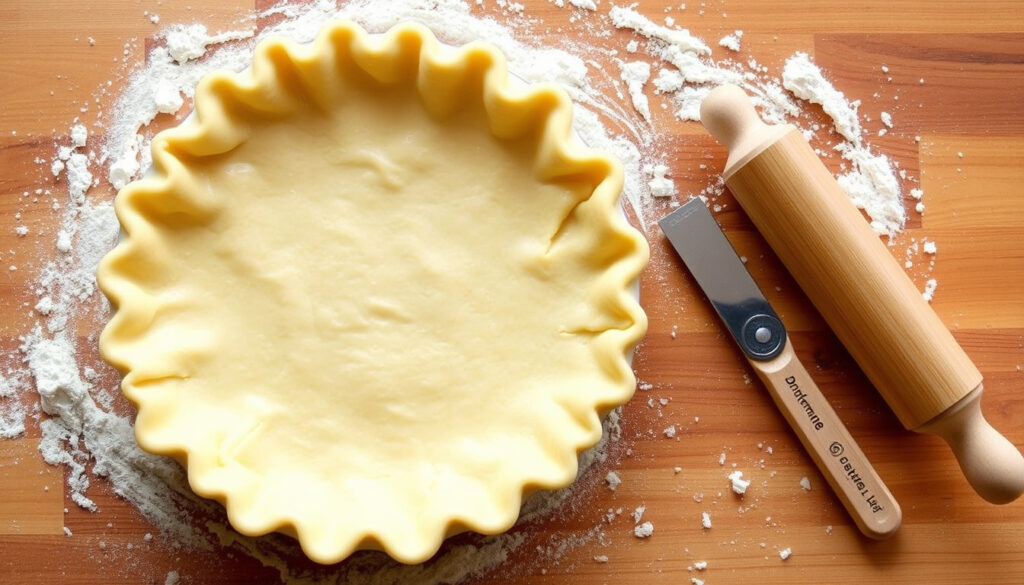
Easy Shortcrust Pastry Recipe: Perfect Flaky Pie Crust Every Time
There’s a quiet confidence that comes from pulling a perfect, golden pie crust out of the oven — especially when you made it from scratch. Getting that flaky, tender shortcrust pastry is less about magic and more about understanding two key things: the ratio of fat to flour and the way you handle the dough. This guide walks through the classic method (hands-on or with a food processor) and explains the science that prevents a tough crust.
Flour to butter ratio: 2:1 by weight (e.g., 200g flour to 100g butter) ·
Preparation time: 15 minutes ·
Chilling time: 30 minutes ·
Baking temperature: 190°C (375°F) ·
Difficulty: Easy
Quick snapshot
- Flour, butter, water, salt (Jacksons Job)
- Chill 30 min (Jacksons Job)
- Bake blind for wet fillings (Jacksons Job)
- Add sugar and often an egg yolk
- Used for tarts and desserts
- Bakes slightly darker
- Omit sugar, add herbs or cheese
- For quiches, pies
- Often baked with filling
- Keep ingredients cold (Top With Cinnamon)
- Don’t overwork dough (Top With Cinnamon)
- Rest before rolling (Top With Cinnamon)
Facts at a glance: the details that define how much time you’ll need, what you’ll get, and how hard it is.
| Total time | 45 minutes (including chilling) |
| Yield | One 9-inch (23 cm) pie crust |
| Difficulty | Easy |
| Key ingredient | Cold butter |
How do you make a shortcrust pastry?
Ingredients you’ll need
The foundation is flour, fat, water, and a pinch of salt. Standard shortcrust pastry uses 300 grams of plain flour to 150 grams of butter, a 2:1 ratio by weight, as detailed by Little House Big Alaska (home baking site). Some recipes, like James Martin’s cited by Top With Cinnamon (food blog), include a whole egg to help bind the dough. For sweet crusts, add 1-2 tablespoons of caster sugar; for savory, consider a teaspoon of dried herbs or grated Parmesan.
Step-by-step method
- Cube the fat: Cut cold butter into roughly 1/2-inch (1.27 cm) pieces.
- Rub in: Using fingertips or a pastry cutter, rub the butter into the flour until it looks like coarse breadcrumbs. This coat the flour particles with fat, preventing excess gluten formation.
- Add liquid: Sprinkle ice-cold water over the mixture — about 2 to 4 tablespoons — and bring together with a fork. The liquid amount should be roughly half the volume of the fat.
- Form a disc: Press the dough gently into a disc, wrap in cling film, and chill for at least 30 minutes.
A food processor speeds this up. Per Food Nouveau (cooking technique site), pulse the butter and flour for ten continuous seconds until coarse crumbs form, then add water in short pulses until the dough just begins to clump.
Tips for a flaky crust
Cold ingredients are non-negotiable. Warm butter melts into the flour instead of creating separate flat sheets that steam and lift during baking. A light hand also matters: overworking the dough develops gluten, producing a tough, dense crust instead of a tender one — a warning underscored by Top With Cinnamon. If you have wet fillings like fruit or custard, bake the crust blind (lined with parchment and filled with baking beans) at 190°C (375°F) for 15 minutes before adding the filling.
The entire method hinges on one rule: keep the fat cold and the gluten development minimal. Any cook who lets the dough warm up or over-mixes it will face a shrunken, chewy crust.
What is the ratio of flour to butter when making shortcrust pastry?
Standard 2:1 ratio by weight
By weight, shortcrust pastry almost always follows a 2:1 ratio: two parts flour to one part butter. This is the traditional formula, confirmed by Jacksons Job (recipe resource). A common example is 200 grams flour to 100 grams butter, which yields a balanced dough that’s easy to roll. Some recipes push closer to 3:2:1 (flour:butter:water) as noted by Food Nouveau, which leans slightly leaner for certain fillings.
Adjustments for sweet vs savory
For sweet shortcrust, sugar is added at a rate of about 25-30 grams per 200 grams flour. Because sugar absorbs moisture, you may need an extra tablespoon of water or include an egg yolk. Savory crusts skip the sugar and sometimes swap a portion of butter for lard to increase tenderness.
Why the ratio matters for texture
Fat coats the flour proteins, interfering with gluten formation. Too much fat and the dough becomes greasy and fragile; too little and the crust turns hard and tough. The 2:1 ratio hits the sweet spot where the fat sufficiently shortens the gluten strands while leaving enough structure to hold the dough together during rolling and baking.
The pattern: Fat is not just flavor — it’s the primary tool for controlling texture, and the ratio is the dial you turn.
Should shortcrust pastry be made with plain flour?
Plain flour (all-purpose) is best
Plain flour, also called all-purpose flour, has a moderate protein content (8-10%) that produces a tender but sturdy crust. This is the gold standard for shortcrust, as recommended across nearly every authoritative recipe. The moderate gluten level is enough to hold the pastry together but not so much that it turns tough when worked.
Why self-raising flour is not suitable
Self-raising flour contains baking powder and salt mixed into the flour. When you add liquid, the leavening agents create gas bubbles, which puff up the pastry and cause cracking. Shortcrust needs no lift — it bakes flat and dense. Using self-raising results in a crust that rises unevenly and often breaks apart when rolled.
Gluten content and its effect
Bread flour, with 12-14% protein, develops too much gluten during mixing and rolling. The result is a tough, elastic dough that fights back when you try to shape it — the opposite of what shortcrust should be. For those going gluten-free, a blend of rice flour, potato starch, and a binder like xanthan gum (about 1/4 teaspoon per cup of blend) mimics the structure of plain flour.
Choosing plain flour isn’t a preference — it’s a mechanical requirement. Self-raising or bread flour fundamentally change the chemistry, pushing the crust from tender to puffed or chewy.
The catch: using the wrong flour type cannot be compensated by technique; the dough’s chemistry is set from the start.
Is butter or lard better for shortcrust pastry?
Butter: flavor and browning
Butter gives shortcrust its rich taste and attractive golden color. It contains about 15% water, and that water converts to steam in the hot oven, pushing apart layers of dough and creating flaky pockets. The trade-off: butter has a low melting point, so dough must stay cold throughout handling. If the butter softens before baking, the flaky effect is lost.
Lard: flakiness and tenderness
Lard has a higher melting point than butter and almost no water. Pastry made with lard is extremely tender — it practically crumbles on the tongue — and is easier to work with because the dough stays firm longer. Lard provides a neutral flavor, which makes it ideal for savory pies where you don’t want a buttery taste competing with fillings.
Using a combination for best results
Many experienced cooks, including Jamie Oliver according to Top With Cinnamon, recommend a blend of half butter and half lard. This gives you the flavor and browning of butter with the tenderness and workability of lard. Mary Berry’s classic recipe uses all butter but compensates with a very light touch and thorough chilling.
The trade-off: All-butter = more flavor, more risk of a tough crust. Half-lard = easier texture, neutral taste. The right choice depends on whether you prioritize flavor or foolproof handling.
Do you use plain flour or self-raising flour for shortcrust pastry?
Plain flour is the correct choice
Every authoritative source agrees: shortcrust pastry must be made with plain (all-purpose) flour. The moderate protein content, 8-10%, produces a crust that is tender but strong enough to hold shape. Mary Berry’s shortcrust pastry, for instance, uses 175g plain flour to 85g butter — a perfect example of the standard.
What happens if you use self-raising
Self-raising flour’s built-in leavening (baking powder) causes the pastry to expand and crack. Shortcrust relies on a dense, flaky structure with no air pockets from chemical leaveners. If you use self-raising, the crust puffs, loses its smooth surface, and can break when rolled thin. Plain flour is mandatory for authentic shortcrust.
Gluten-free alternatives
For a gluten-free shortcrust, use a proprietary all-purpose gluten-free blend or make your own: 150g white rice flour, 100g potato starch, 50g tapioca flour, plus 1/2 teaspoon xanthan gum. The xanthan gum replicates the binding action of gluten. Use the same 2:1 flour-to-fat ratio, but add an extra tablespoon of water, as gluten-free flours absorb more moisture.
Confirmed facts & what’s unclear
Confirmed facts
- Flour to butter ratio of 2:1 by weight produces a reliable shortcrust, confirmed by Jacksons Job
- Plain flour is essential; self-raising will alter texture
- Chilling dough prevents shrinkage and improves flakiness
What’s unclear
- Optimal fat choice (butter vs lard) depends on desired outcome
- Exact resting time for optimal gluten relaxation is debated
- Whether to include an egg in shortcrust pastry varies by recipe
The picture: while core ratios and flour choice are settled, minor ingredient decisions remain a matter of preference and recipe tradition.
Expert perspectives on shortcrust pastry
“The key to shortcrust is a light touch. Use 175g plain flour, 85g butter, and 2-3 tbsp water — handle it as little as possible.”
— Mary Berry, home baking authority (BBC Food)
“For the flakiest pie crust, use half butter and half lard. The lard makes it easy to work and the butter gives you the flavor.”
— Jamie Oliver, chef and cookbook author
Both experts agree on the fundamentals but diverge on fat choice. Home cooks seeking guaranteed softness will benefit from lard’s forgiveness; those chasing pure butter flavor must control temperature obsessively.
The pattern: expert consensus on technique doesn’t eliminate the need for a personal choice based on your priorities.
Summary: the baker’s choice
Shortcrust pastry is a simple recipe with a high-stakes dependence on technique. The 2:1 flour-to-butter ratio, cold handling, and plain flour are non-negotiable pillars. Where personal judgment enters is fat selection: all-butter for peak flavor but a narrower window of success, or a butter-lard hybrid for a consistently tender crust that rolls without cracking. For the home baker making a pie for the weekend, the choice between butter’s taste and lard’s ease is the central decision. Go with half and half for a forgiving first attempt, or go all-butter with strict heat control to master the classic French pâte brisée.
feastgloriousfeast.com, busycreatingmemories.com, thelunacafe.com, recipetineats.com
Frequently asked questions
Can I use margarine instead of butter?
Margarine has a higher water content and lower fat content than butter. It can work, but the crust will be less flaky and more prone to shrinkage. For best results, use block margarine, not spreadable tub margarine, as the latter contains too much water.
Why is my shortcrust pastry tough?
Toughness comes from overworking the dough, which develops gluten. You may have rubbed the fat in too thoroughly, kneaded the dough, or used water that wasn’t ice-cold. Next time, stop mixing as soon as the dough comes together.
How do I prevent pastry from shrinking?
Dough shrinkage occurs when gluten hasn’t relaxed enough. Rest the wrapped dough in the fridge for at least 30 minutes. Also, do not stretch the dough when lining the tin — gently press it in place.
Can I make shortcrust pastry ahead and freeze it?
Yes. Wrap the dough disc tightly in cling film, then place in a freezer bag. It will keep for up to three months. Thaw overnight in the refrigerator before rolling. Bake directly from frozen if wrapped and stored properly.
What is the best way to roll out shortcrust pastry?
Lightly flour your work surface and the rolling pin. Roll from the center outward, turning the dough a quarter turn after each roll to maintain an even circle. If the edges crack, let the dough warm for 2 minutes and press cracks back together.
How do I fix pastry that is too dry?
Sprinkle one teaspoon of ice-cold water over the dough and work it in gently with your fingertips. Do not add more than 2 teaspoons total, or the dough will become sticky. If it’s still too dry, try adding a teaspoon of lemon juice or vinegar, which tenderizes the gluten.
Can I make a gluten-free shortcrust pastry?
Yes. Use a gluten-free all-purpose blend that includes xanthan gum. Follow the same 2:1 flour-to-fat ratio, but add an extra 1-2 tablespoons of cold water because gluten-free flours absorb more moisture. The dough will be more fragile, so press rather than roll it into the tin.
Related reading: How to Make Rice Pudding · How to Make Chia Pudding
More related posts
 FA Cup Quarter Final Draw 2025-26: Results and Fixtures
 White Fox Discount Code 2026: 20% Off + Student Deals
 11.5 Stone to Kilograms – Accurate Conversion & BMI
 Terminator 2D No Fate – Guide to Defeating Skynet Machines
 Paul Lim: Nine-Dart Finish and Oldest PDC Match Winner
 Boots Morning After Pill: Free NHS & Over-the-Counter Options
 Senegal National Football Team Standings: WC, AFCON, FIFA
 Stefanie Martini: Nationality, Height, Relationship & Career