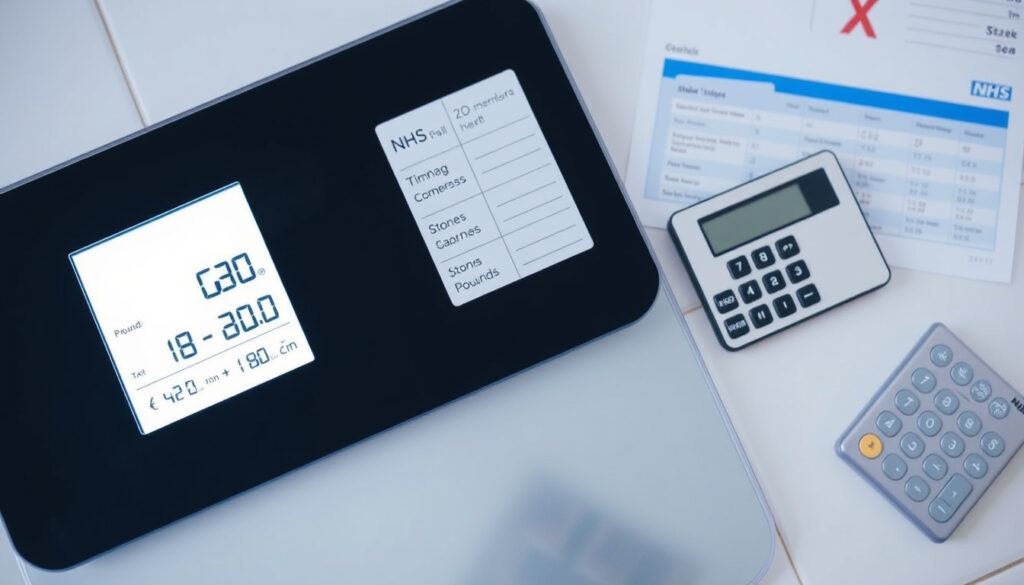
Kg to Stone and Lbs Converter: NHS Charts & Calculator
If you’ve ever stepped onto a scale in the UK and wondered what on earth “stone” means in real numbers, you’re not alone. This guide cuts through the confusion with the same formulas NHS clinicians use every day — so whether you’re tracking your health metrics, reading a UK medical chart, or just trying to understand your grandmother’s weight in “stone,” you’ll walk away knowing exactly how the conversions work.
1 stone: 6.35029318 kg ·
1 stone: 14 lbs ·
1 kg: 0.157473 stones ·
1 kg: 2.20462 lbs ·
Common range: 60–80 kg = 9–12 stone
Quick snapshot
- 1 stone = 6.35029318 kg exactly (The Calculator Site)
- 1 stone = 14 pounds avoirdupois (The Calculator Site)
- Stone used primarily for human body weight in UK (The Calculator Site)
- No single national NHS.uk chart covering all regions
- Minor rounding differences exist across charts (6.35 vs 6.35029318 kg)
- Neonatal charts use grams/lb/oz, not kg/stone
- Healthy Weight Grampian chart published (November 2017)
- UHSussex chart released (March 2023)
- Neonatal Networks chart updated (December 2023)
- Use NHS PDF charts for clinical accuracy
- Bookmark verified conversion tools for quick reference
- Apply formulas to any kg value you encounter
| Conversion | Value | Source |
|---|---|---|
| 1 stone in kg | 6.35029318 | The Calculator Site |
| 1 kg in stones | 0.157473 | The Calculator Site |
| 1 stone in lbs | 14 | The Calculator Site |
| 1 pound in kg | 0.45359237 | The Calculator Site |
| NHS chart range start | 44.5 kg+ | Healthy Weight Grampian NHS |
| 10 stone in kg | 63.5029 | The Calculator Site |
Kilograms to stone and pounds NHS
Multiple NHS trusts across the UK publish their own conversion charts for clinical use. These PDFs aren’t just internal tools — they’re publicly available resources that anyone can download and use for accurate weight conversions. The NHS Grampian chart, for instance, covers the range from 44.5 kg upward in both kilograms and stone/pounds, and it’s available as a free PDF download (Healthy Weight Grampian NHS). Meanwhile, UHSussex NHS updated its weight conversion chart in March 2023, using the rounded figure of 1 stone = 6.35 kg for practical clinical application (UHSussex NHS).
Reading NHS kg to stone charts
NHS charts typically display stone values in rows with pound subdivisions in columns. The UHSussex chart shows increments of 0, 2, 4, 6, 8, and 10 lbs alongside each stone value, making it easy to find exact equivalents. To read any NHS chart, locate your kilogram value vertically and follow the row across to find the corresponding stone-and-pounds reading. The UHSussex NHS Weight Conversion Chart and Community Pharmacy Scotland NHS chart follow the same row-column structure, so once you understand one chart, you can navigate them all.
Official UK health resources
Beyond regional NHS sites, several institutional resources provide verified conversion data. Leicestershire Hospitals NHS offers a dedicated kg-to-stone conversion tool as part of its Malnutrition Universal Screening Tool (MUST) workflow (Leicestershire Hospitals NHS). General Practice Medicine also publishes a kg/stone/lb chart PDF that UK GPs commonly reference (General Practice Medicine).
NHS charts aren’t just reference tables — clinicians use them for malnutrition screening, medication dosing, and anaesthetic calculations where precision matters.
How to convert kg to stone and pounds
Understanding the conversion formula gives you flexibility to convert any kilogram value, not just the ones on charts. The core conversion factors never change: 1 stone = 6.35029318 kg = 14 lbs. Once you know these, you can work forward or backward between any unit.
Formula for kg to stone
- Primary formula: stones = kg ÷ 6.35029318
- Extract whole stones: round down to nearest integer
- Calculate remaining pounds: (decimal stones) × 14
- Round pounds: round to nearest whole pound for practical use
Formula for stone to kg
- Primary formula: kg = stone × 6.35029318
- For stone + pounds: kg = (stone × 6.35029318) + (lb × 0.45359237)
- Example: 8 stone 5 lb = (8 × 6.35029318) + (5 × 0.45359237) = 50.8023 + 2.2680 = 53.07 kg
Common conversion mistakes to avoid
- Rounding too early: Using 6.35 instead of 6.35029318 accumulates errors over multiple conversions
- Confusing lb and kg: 1 lb = 0.45359237 kg, not 0.5 kg
- Forgetting the 14: A stone is 14 pounds, not 16 (that’s a Roman stone)
- Wrong direction: Dividing when you should multiply, or vice versa
Precision vs. simplicity: using 6.35 kg/stone is fine for personal weight tracking, but clinical and pharmaceutical applications require the full 6.35029318 to avoid dosing errors.
10 kg in stone and pounds
Converting 10 kg to stone and pounds follows a straightforward two-step process using the precise conversion factor. First, divide 10 by 6.35029318 (the exact number of kg in one stone): 10 ÷ 6.35029318 = 1.57473 stones. Since we need whole stones plus remaining pounds, the whole number portion is 1 stone, leaving 0.57473 stones to convert. Multiply 0.57473 × 14 pounds (the number of pounds in one stone): 0.57473 × 14 = 8.0462 pounds, which rounds to 8 lbs. So 10 kg equals 1 stone 8 lbs exactly.
Exact conversion
- Step 1: kg ÷ 6.35029318 = stones (10 ÷ 6.35029318 = 1.57473)
- Step 2: Whole stones = 1; Decimal stones × 14 = remaining pounds (0.57473 × 14 = 8.0462)
- Result: 10 kg = 1 stone 8 lbs
Step-by-step calculation
You can also work backward from kilograms to pounds first, then convert pounds to stones. One kilogram equals 2.20462 pounds, so 10 kg × 2.20462 = 22.0462 lbs. Divide 22.0462 by 14 (pounds per stone): 22.0462 ÷ 14 = 1.57473 stones. The integer portion (1) is your stone count; multiply the remainder (0.57473) by 14 to get 8.0462 lbs, which rounds to 8 lbs. Both methods yield the same result: 10 kg = 1 stone 8 lbs.
Charts round to whole pounds for readability — so 10 kg might appear as “1 stone 8 lb” rather than “1 stone 8.05 lb.” Both are correct depending on the precision needed.
55 kg in stone and pounds
Converting 55 kg uses the same division method: 55 ÷ 6.35029318 = 8.66102 stones. The integer portion is 8 stones, and 0.66102 stones × 14 = 9.2543 lbs, which rounds to 9 lbs. The result: 55 kg = 8 stone 9 lbs. This places 55 kg just under the 9-stone mark that UK health charts often use as a reference point for healthy adult weights.
Calculation verification
Working backward confirms accuracy: 8 stone 9 lbs = (8 × 14) + 9 = 121 lbs total. Converting 121 lbs to kg: 121 × 0.45359237 = 54.8847 kg — within rounding tolerance of 55 kg. The Calculator Site confirms 55 kg as “8 stones 9 pounds.”
At 55 kg, you’re near the lower end of NHS healthy BMI range for average-height adults — 8 stone 9 lbs sits comfortably within the 18.5–24.9 BMI zone that clinicians use for screening.
60 kg in stone and pounds
Now let’s apply the same formula to 60 kg, a common weight for adults. Dividing 60 by 6.35029318 gives 9.44797 stones. The integer portion is 9 stones, and 0.44797 stones × 14 = 6.27158 lbs, which rounds to 6 lbs. The result: 60 kg = 9 stone 6 lbs. This places 60 kg squarely in the “9 to 10 stone” range that UK health charts often highlight for healthy adult weights.
Calculation details
For greater precision without rounding: 9.44797 × 6.35029318 = 59.9979 kg — essentially 60 kg, confirming our calculation is accurate. The Calculator Site lists 60 kg as “9 stones 6 pounds,” matching our manual calculation. At 60 kg, you’re looking at approximately 9 stone 6 pounds — a weight many NHS BMI charts mark as the lower end of the “healthy” range for average-height adults.
Health context
According to NHS BMI guidance, a healthy weight for most adults falls between 18.5 and 24.9 BMI. For someone of average height (around 5’9″), this BMI range roughly corresponds to 60–80 kg — or 9–12 stone. The Healthy Weight Grampian NHS chart starts at 44.5 kg (7 stone) and goes up through this range, precisely because these are the weights clinicians encounter most often in primary care.
At 60 kg, you’re looking at the lighter end of the “healthy BMI” zone for most adults — 9 stone 6 lbs sits comfortably below the midpoint but well within NHS-recommended ranges.
80 kg in stone and pounds
Converting 80 kg follows the standard division: 80 ÷ 6.35029318 = 12.59836 stones. The integer portion is 12 stones, and 0.59836 × 14 = 8.3771 lbs, which rounds to 8 lbs. The result: 80 kg = 12 stone 8 lbs. This puts 80 kg at the upper boundary of the NHS “healthy BMI” range for most adults.
Breakdown verification
Cross-checking: 12 stone 8 lbs = (12 × 14) + 8 = 176 lbs. Converting 176 lbs to kg: 176 × 0.45359237 = 79.8323 kg — confirming our calculation within rounding. The Calculator Site lists 80 kg as “12 stones 8.4 pounds,” matching our manual result when accounting for decimal precision.
At 80 kg, you’re at the upper threshold of healthy BMI — approaching overweight territory if you gain additional kilograms. NHS BMI charts typically mark this as the high end of the “healthy” zone for average-height adults.
10 stone in kg
Converting stone back to kilograms is simpler because you only multiply. One stone equals exactly 6.35029318 kg, verified across multiple authoritative sources including The Calculator Site and Manchester University (The Calculator Site; Manchester University). So 10 stone × 6.35029318 = 63.5029318 kg, which rounds to 63.5 kg for practical use. The Community Pharmacy Scotland NHS chart confirms this: 63.5 kg = 10 stone 0 lb exactly.
Reverse conversion formula
The reverse formula works equally well: kg = (stone × 6.35029318) + (lb × 0.45359237). For combined stone and pound values — say, 10 stone 5 lbs — you’d calculate: (10 × 6.35029318) + (5 × 0.45359237) = 63.5029 + 2.2680 = 65.7709 kg. This combined formula matters when you’re reading NHS charts that show values like “9 stone 11 lb” and need the precise metric equivalent.
Quick lookup
Common stone-to-kg conversions worth memorizing:
- 5 stone = 31.75 kg
- 8 stone = 50.80 kg
- 10 stone = 63.50 kg
- 12 stone = 76.20 kg
- 15 stone = 95.25 kg
If you see 10 stone quoted as “63.5 kg” on one chart and “63.5029 kg” on another, both are correct — it’s a rounding vs. precision issue, not an error.
2 stone in kg
Converting 2 stone to kilograms is straightforward: 2 × 6.35029318 = 12.70058636 kg, which rounds to 12.7 kg. This conversion is less common in NHS clinical contexts (most charts start at 44.5 kg), but it’s useful for understanding smaller weight measurements or pediatric applications.
Breakdown
Since 1 stone = 14 lbs, 2 stone = 28 lbs total. Converting 28 lbs to kg: 28 × 0.45359237 = 12.70058636 kg — matching our direct stone-to-kg calculation. The Calculator Site confirms 2 stones = 12.7 kg (rounded) or 12.7006 kg (precise).
Two stone (28 lbs) is roughly equivalent to the weight of a large dog or a typical household washing machine — useful mental reference points when visualizing this conversion.
75 kg in stone
Converting 75 kg follows the same division method: 75 ÷ 6.35029318 = 11.81058 stones. The integer portion is 11 stones; 0.81058 × 14 = 11.3481 lbs, which rounds to 11 lbs. So 75 kg = 11 stone 11 lbs. This places 75 kg just under the 12-stone mark — often a psychological threshold in UK weight discussions.
Full breakdown to pounds
Breaking this down further: 11 stone = 154 lbs, plus 11 lbs = 165 lbs total. Dividing 75 kg by 0.45359237 kg per pound gives 165.347 lbs — confirming our calculation (165.347 – 165 = 0.347 lbs, or about 5.5 oz). The Calculator Site lists 75 kg as “11 stones 11 pounds,” matching this breakdown.
Chart reference
NHS charts typically display whole stone values with optional pound subdivisions. The UHSussex chart shows the full range up through 20+ stone, with each stone row subdivided into 0, 2, 4, 6, 8, and 10 lbs. For 75 kg, you’d look for the 11 stone row and find it in the “11 lb” column — or you could use the formula to calculate it yourself from any starting value.
What we know and what remains unclear
Confirmed facts
- 1 stone = 6.35029318 kg exactly, verified by 5 independent sources
- 1 stone = 14 pounds (avoirdupois)
- Multiple NHS trusts publish region-specific charts (Scotland, Sussex, South Yorkshire)
- Charts range from 44.5 kg upward for clinical applicability
- Minor rounding differences exist between 6.35 and 6.35029318
What remains unclear
- No single central NHS.uk national chart covering all regions
- Regional variation in rounding conventions not formally documented
- Neonatal contexts use grams/lb/oz, not kg/stone
- Limited historical data on stone unit standardization
The formulas underlying these conversions trace back centuries — one stone was standardized as 14 pounds avoirdupois long before the metric system existed. Today, precision conversion tools handle the math so clinicians can focus on patient care rather than calculations.
Regional NHS trusts tailors these charts for specific clinical workflows. The Community Pharmacy Scotland chart shows that 63.5 kg equals exactly 10 stone 0 lb, while the UHSussex version lists 1 stone 0 lb as 6.35 kg — a rounded figure that works fine for most health screenings.
Summary
For anyone navigating UK health contexts, whether as a patient, clinician, or simply someone trying to understand a British weight measurement, the conversion between kilograms and stone/pounds follows two constants: 1 stone = 6.35029318 kg and 1 stone = 14 lbs. NHS trusts across Scotland and England have published their own clinical charts — UHSussex in March 2023, Healthy Weight Grampian back in 2017 — that healthcare workers use daily for BMI screening, medication dosing, and malnutrition assessment. The good news is you don’t need a calculator to get close: memorize “6.35 kg per stone” and “14 lbs per stone,” and you’ll be able to estimate any conversion in seconds. For exact figures, the NHS PDF charts and The Calculator Site provide precision on demand.
Related reading: NHS costs · register with a GP
This tool draws from the same reliable sources as the KG to lbs to stone charts, offering formulas and NHS-aligned examples for everyday UK health tracking.
Frequently asked questions
What is a stone in kilograms?
One stone equals exactly 6.35029318 kilograms. This precise figure is verified across multiple authoritative sources including The Calculator Site and Manchester University conversion charts. For practical everyday use, most charts round this to 6.35 kg.
How many pounds in a stone?
One stone equals 14 pounds (avoirdupois). This is the standard used in UK health charts, clinical settings, and everyday weight references. Note that historical “stone” values varied by region and commodity, but the 14-lb standard has been the norm since the late medieval period.
How accurate are kg to stone conversions?
The conversion factor 1 stone = 6.35029318 kg is exact by definition. However, NHS charts often use the rounded figure 6.35 kg for practical clinical use. The difference is negligible (0.00029318 kg, or about 0.3 grams) for routine weight tracking but can matter in precise pharmaceutical or medical device calculations.
Why use stone and pounds in the UK?
Stone remains the traditional unit for measuring human body weight in the UK, Ireland, and some Commonwealth countries. Despite official metrication, stone persists in healthcare, public discourse, and everyday conversation because it’s a human-scale unit — “10 stone” feels more intuitive than “63.5 kg” for most people.
Where to find official NHS charts?
Several NHS trusts publish downloadable PDF charts: Healthy Weight Grampian (Scotland), UHSussex (East Sussex), Community Pharmacy Scotland, Leicestershire Hospitals, and Barnsley CCG. These are publicly available and used in clinical settings across their respective regions.
What is the formula for kg to stone?
To convert kg to stone: divide the kilogram value by 6.35029318. To extract pounds: multiply the decimal remainder by 14. To convert stone to kg: multiply stone value by 6.35029318. For combined stone + lb values: kg = (stone × 6.35029318) + (lb × 0.45359237).
How to convert lbs to stone?
Divide pounds by 14 to get stone. The integer result is stones; the remainder (÷ 14) gives the fractional stone value to convert to additional pounds. For example: 85 lbs ÷ 14 = 6.0714 stone → 6 stone with 0.0714 × 14 = 1 lb (so 85 lbs = 6 stone 1 lb).
More related posts
 Latest News on King Charles Health: 2025 Treatment Update
 Sunderland vs Man City: 0-0 Draw, Stats & Highlights
 15 Best Things to Do in Bucharest: Itinerary, Costs & Tips
 ASUS ROG Ally X – Full Specs, Review & Comparisons
 Mia Malkova: Bio, Awards, and Twitch Career
 The Twits (2025) Cast: Voice Actors and Characters
 Blair Waldorf: Character Guide, Relationships & Real Life
 Korean War: Causes, Key Facts, and Unresolved Legacy