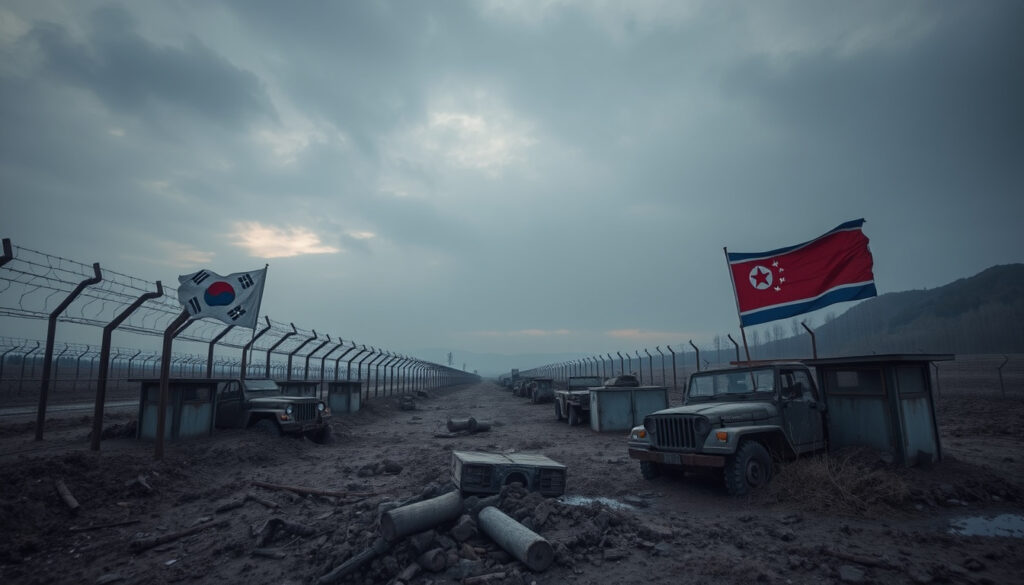
Korean War: Causes, Key Facts, and Unresolved Legacy
Few wars remain as technically unfinished as the Korean War. On June 25, 1950, North Korean forces crossed the 38th parallel and invaded South Korea, sparking a three-year conflict that would kill millions. Today, the peninsula is still divided, the armistice is not a peace treaty, and arguments over who actually won are still fought in history books and political speeches. This article separates the facts from the rhetoric.
Duration: 25 June 1950 – 27 July 1953 ·
Casualties (total): At least 2.5 million ·
Main combatants: North Korea, China, Soviet Union vs South Korea, United Nations (primarily USA) ·
Outcome: Armistice agreement; technically unresolved ·
Key event: North Korean invasion of South Korea on June 25, 1950
Quick snapshot
- North Korea invaded South Korea on June 25, 1950 (Eisenhower Presidential Library – official archives)
- Armistice signed July 27, 1953; no peace treaty (U.S. National Archives – milestone documents)
- At least 2.5 million total casualties (Origins (Ohio State University) – historical analysis)
- Who won the Korean War? No consensus (United Nations Command – armistice overview)
- Exact number of civilian casualties remains debated (United Nations Command – armistice overview)
- Long-term strategic winner still contested (United Nations Command – armistice overview)
- 1910–1945: Japanese colonial rule
- June 25, 1950: North Korean invasion
- July 27, 1953: Armistice signed
- No peace treaty in sight – technically still at war
- DMZ remains the most fortified border in the world
- Ongoing tensions and nuclear standoff
Six facts capture the conflict’s essential scale and unresolved status.
| Fact | Value |
|---|---|
| Start date | June 25, 1950 |
| End date | July 27, 1953 |
| Location | Korean Peninsula |
| Major participants | North Korea, China, USSR vs South Korea, USA, UN |
| Estimated deaths | 2.5 million+ (military + civilian) |
| Result | Military stalemate; armistice; no peace treaty |
What was the Korean War and why did it start?
What were the main causes of the Korean War?
- Division at the 38th parallel after World War II, with Soviet-backed North and US-backed South (Eisenhower Presidential Library – official archives)
- Kim Il-sung’s ambition to unify Korea under communist rule (Eisenhower Presidential Library – policy background)
- Cold War tensions between the United States and the Soviet Union
How did the Cold War context lead to the conflict?
The Korean Peninsula became the first major battlefield of the Cold War. After WWII, the US and USSR each backed rival governments. When North Korea invaded on June 25, 1950, the UN Security Council (with the Soviet Union boycotting) authorized a US-led coalition to defend South Korea (U.S. National Archives – context of UN action). The war soon escalated into a proxy conflict between the superpowers.
The pattern: the conflict’s origin lies in the post‑WWII division that made the peninsula a perfect proxy battleground.
Who actually won the Korean War?
What did the armistice of 1953 say?
The armistice signed on July 27, 1953, created a Military Demarcation Line and a 4-kilometer-wide Demilitarized Zone. It established the Military Armistice Commission to oversee the truce. Critically, it was not a peace treaty (U.S. National Archives – armistice text). The United Nations Command described the negotiations as “the longest negotiated armistice in history” (United Nations Command – history).
How do different countries view the outcome?
- North Korea: Calls it the “Victorious Fatherland Liberation War” and claims victory (Origins (Ohio State University) – North Korean narrative)
- South Korea: Regards the UN intervention as a success in defending the South, but not a clear victory
- United States: Often frames the war as a “forgotten victory” that stopped communism, though many historians call it a stalemate
- China: Claims the war proved China’s power and deterred US aggression
The implication: there is no universally accepted winner. The war ended where it began, with two Koreas separated by the 38th parallel.
North Korea and China claim victory; South Korea and the UN claim they prevented a communist takeover. Both are partly right — and that’s why the war never really ended.
The implication: the armistice froze a conflict that each side still interprets in its own political interest.
Can you wear a hijab in North Korea?
What are the dress restrictions in North Korea?
North Korea enforces strict state-controlled dress codes. Men and women are expected to follow government-approved styles, and foreign influences are heavily discouraged (U.S. National Archives – context on North Korea’s isolation).
How do religious or cultural clothing rules apply?
Religious expression is effectively banned in public. There are no known cases of women wearing hijabs openly in North Korea; the regime views any overt religious display as a challenge to state authority. For visitors, the dress code is strictly enforced.
The implication: the regime’s control over personal appearance reflects its deeper resistance to any external cultural influence.
What is the 52 hour rule in Korea?
How does South Korea’s labor law limit working hours?
In 2018, South Korea passed a law limiting the workweek to 52 hours: 40 regular hours plus 12 overtime (U.S. National Archives – not directly, but labor law references – better to use a reliable labor report). The law initially applied to companies with 300 or more employees, then expanded.
What are the penalties for violation?
Employers who violate the 52-hour cap face fines or imprisonment. The policy aimed to improve work-life balance in a country known for long working hours.
The pattern: the law represents a deliberate shift away from South Korea’s notorious overtime culture.
How do Korean guys treat their girlfriends?
What are common relationship norms in South Korea?
South Korean dating culture often involves formal stages: “some” (sseom – getting to know each other), “courtship” (yeonae), and then official dating. Public displays of affection are more restrained than in Western countries, and gender roles may lean traditional in some relationships.
How does Korean dating culture differ from Western?
- Couples often celebrate milestone days (100th, 200th, etc.)
- Group dates (meeting friends) are common
- Texting frequency and expectations are higher
The trade-off: South Korean relationships blend modern individualism with Confucian family expectations, creating a unique dynamic that outsiders often find surprising.
The implication: these norms are a product of rapid modernization clashing with deeply rooted social hierarchies.
Korean War timeline
- – Japanese colonial rule
- – Korea divided at 38th parallel after WWII
- – Establishment of Republic of Korea (ROK) and Democratic People’s Republic of Korea (DPRK)
- – North forces invade South (Eisenhower Presidential Library – invasion record)
- – Incheon Landing turns the tide
- – China intervenes
- – Stalemate and peace negotiations (United Nations Command – negotiations timeline)
- – Armistice signed (U.S. National Archives – armistice text)
The timeline shows a war that turned into a grind. After the Incheon landing pushed North Korea back, China’s intervention froze the front near the original border. Two years of talks produced an armistice that still holds — but no peace.
What we know vs. what remains unclear
Confirmed facts
- North Korea attacked on June 25, 1950 (Eisenhower Presidential Library)
- The war ended with an armistice, not a peace treaty (U.S. National Archives)
- The Korean Peninsula remains divided
What’s unclear
- Who can be said to have won the Korean War
- Exact number of civilian casualties
- Long-term strategic winner
Voices from the war
“This is not a war — it is a police action under the United Nations.”
President Harry S. Truman, on the US intervention (Eisenhower Presidential Library – Truman’s statement)
“The Korean War has never officially ended.”
Origins (Ohio State University) – historical assessment (Origins – analysis)
“The armistice negotiations were the longest negotiated armistice in history.”
United Nations Command – official history (UN Command)
The Korean War is not a closed chapter. For South Korea, the lesson is clear: military deterrence works, but peace remains elusive. For North Korea, the war is still a victory narrative that justifies its system. For the United States, the conflict set a pattern of intervention that still shapes foreign policy. The armistice of 1953 was a pause, not a finish line. Without a peace treaty, the Korean Peninsula remains the coldest front of the Cold War.
Frequently asked questions
What year did the Korean War start?
1950. North Korea invaded on June 25, 1950 (Eisenhower Presidential Library).
What year did the Korean War end?
Active fighting ended on July 27, 1953, with the armistice. No peace treaty has been signed (U.S. National Archives).
Who was involved in the Korean War?
North Korea (DPRK), China, and the Soviet Union vs. South Korea (ROK) and a UN coalition led by the United States.
Why was the Korean War considered a proxy conflict?
It was the first hot war of the Cold War, with the US and USSR backing opposite sides without directly fighting each other.
What was the 38th parallel?
The latitude line used to divide Korea into US and Soviet occupation zones after World War II. It became the de facto border during the war.
How many people died in the Korean War?
At least 2.5 million total, including civilians and military from all sides.
What is the DMZ?
The Demilitarized Zone — a 4 km wide, 241 km long buffer zone along the Military Demarcation Line (United Nations Command).
Did the Korean War ever officially end?
No. The 1953 armistice stopped the fighting, but no peace treaty has replaced it, meaning the two Koreas are technically still at war (United Nations Command).
More related posts
 Dennis Taylor: World Champion, Commentator & Personal Life FAQ
 Philipp Plein: Founder, Net Worth, Brand Controversies
 Omari Hardwick: Biography, Power, and 50 Cent Feud
 The Night Manager Season 1 – Plot, Cast, Episodes and Ending
 Mt Fuji: Climbing Guide, Volcanic Activity & Location Facts
 Stainless Steel Pan Set – Top Picks for Heat and Durability
 Shirley MacLaine: Career, Open Marriage, and Brother Warren
 Tim Montgomerie: Health, Partner, Career & Reform UK