What Is an Isotope? Simple Definition, Examples, and Uses
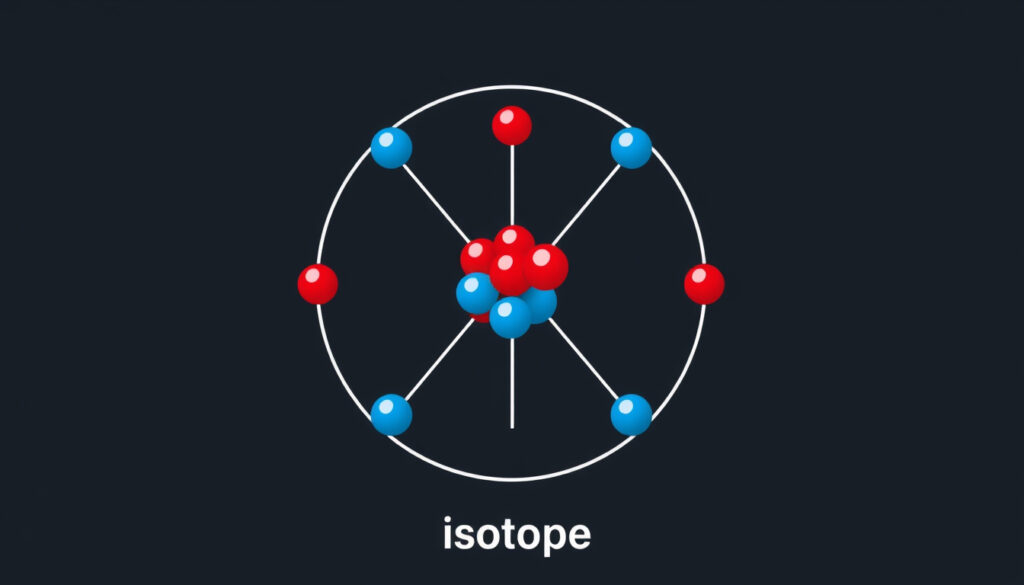
You’ve probably come across the term “isotope” in a science class or during a documentary, but what does it actually mean? Put simply, an isotope is a version of an element that has the same number of protons but a different number of neutrons. That one difference unlocks everything from carbon-dating ancient artifacts to treating cancer — and it’s a lot simpler than it sounds.
Number of stable isotopes known: 254 ·
Number of radioactive isotopes known: over 3,000 ·
Element with the most stable isotopes (tin): 10 ·
Elements with only one stable isotope (e.g., gold, aluminum): 21 ·
First isotope discovered (neon-20 and neon-22 by J.J. Thomson): 1913
Quick snapshot
- Same element, different number of neutrons (U.S. Department of Energy)
- Same atomic number, different mass number (U.S. Department of Energy)
- Start with hydrogen: protium, deuterium, tritium (U.S. Department of Energy)
- 254 known stable isotopes (National Isotope Development Center)
- Do not decay (National Isotope Development Center)
- Example: carbon-12, oxygen-16 (National Isotope Development Center)
- Tin has 10 stable isotopes (most) (National Isotope Development Center)
- Over 3,000 known (International Atomic Energy Agency)
- Decay over time, emit radiation (International Atomic Energy Agency)
- Used in medicine, dating, power (International Atomic Energy Agency)
- Example: carbon-14, uranium-235 (International Atomic Energy Agency)
- Medical imaging and therapy (U.S. Department of Energy)
- Carbon dating (U.S. Department of Energy)
- Nuclear energy (U.S. Department of Energy)
- Scientific research (NMR, tracers) (U.S. Department of Energy)
Five key facts, one pattern: the number of neutrons is the only variable that turns a stable element into a tool for dating, imaging, or powering a reactor.
The pattern: this one variable—neutron count—determines whether an isotope sits passively in nature or actively works in medicine and energy.
| Fact | Value |
|---|---|
| Isotopes of hydrogen | 3: protium (0 neutrons), deuterium (1), tritium (2) (U.S. Department of Energy) |
| Most abundant isotope of carbon | Carbon-12 (98.89%) (National Isotope Development Center) |
| Element with most stable isotopes | Tin (Sn) — 10 stable isotopes (National Isotope Development Center) |
| Rarest natural element | Astatine (<1 g in Earth's crust) (U.S. Department of Energy) |
| Year first isotope discovered | 1913 (J.J. Thomson, neon) (International Atomic Energy Agency) |
What is an isotope in simple terms?
Atoms of the same element always have the same number of protons — that’s what defines an element. But the number of neutrons can vary. These different versions are called isotopes. For example, hydrogen usually has one proton and one electron, and no neutrons. But when you add a neutron, you get deuterium; add two neutrons and you get tritium. All three are still hydrogen because they each have one proton (U.S. Department of Energy).
This tiny difference in the nucleus matters a lot: it changes the atom’s mass, and for some isotopes, it makes the nucleus unstable — leading to radioactive decay. But the chemical behavior stays nearly identical because the electron count is unchanged (National Isotope Development Center).
Isotope definition for beginners
- Same element = same number of protons.
- Different version = different number of neutrons.
- Example: carbon-12 (6 protons, 6 neutrons) vs. carbon-14 (6 protons, 8 neutrons).
The International Atomic Energy Agency defines isotopes simply as “forms of a chemical element” — a starting point that leads to everything from nuclear medicine to dating ancient fossils.
How to explain isotope to a child
Think of LEGO bricks: you have the same 2×4 brick (the element), but you can add different numbers of extra studs (neutrons) on top. Same brick, different weight. That’s an isotope. Hydrogen is like a brick with no extra studs; deuterium has one extra; tritium has two. They’re all still hydrogen, just heavier versions (U.S. Department of Energy).
The same-proton/different-neutron rule is the single most important concept. Without it, carbon dating, PET scans, and nuclear power would all be impossible. Students who grasp this one distinction unlock the entire field of nuclear science.
What are 5 examples of isotopes?
A few common examples show the range — from stable workhorses to radioactive specialists.
Common stable isotopes
- Carbon-12 and Carbon-13 — stable; carbon-12 makes up 98.89% of all carbon on Earth (U.S. Department of Energy).
- Chlorine-35 and Chlorine-37 — natural chlorine is about 76% Cl-35 and 24% Cl-37 (National Isotope Development Center).
- Oxygen-16, Oxygen-17, Oxygen-18 — stable isotopes used in climate science and metabolic studies (National Isotope Development Center).
- Tin-112 through Tin-124 — tin has 10 stable isotopes, more than any other element (National Isotope Development Center).
Radioactive isotope examples
- Carbon-14 — radioactive, decays with a half-life of about 5,730 years, used for dating (U.S. Department of Energy).
- Uranium-235 — fissile isotope used in nuclear reactors and weapons; uranium-238 is the most common but not fissile (U.S. Department of Energy).
- Iodine-131 — radioactive isotope used to treat thyroid cancer (U.S. Department of Energy).
- Cobalt-60 — used in radiation therapy and sterilization (National Isotope Development Center).
- Strontium-82 — decays to rubidium-82 with a half-life of 25 days; used in heart imaging generators (National Isotope Development Center).
What this means: stable isotopes give us a baseline for natural abundance, while radioactive isotopes are designed to break down — and that decay is precisely what makes them useful.
What is an isotope used for?
Isotopes aren’t just textbook curiosities — they’re deployed in medicine, archaeology, industry, and energy production every day.
Medical applications
- Technetium-99m is used in 80% of nuclear medicine procedures for imaging organs (U.S. Department of Energy).
- Iodine-131 targets thyroid cancer cells selectively (National Isotope Development Center).
- Cobalt-60 sources sterilize medical equipment and treat tumors (National Isotope Development Center).
- Rubidium-82 (from strontium-82 generators) images heart blood flow (National Isotope Development Center).
Archaeological dating
Carbon-14 dating measures the decay of radioactive carbon in organic remains. The technique works for samples up to about 50,000 years old and has been a standard archaeological tool since the 1960s (Khan Academy (educational platform)).
- Carbon-14 half-life: 5,730 years (U.S. Department of Energy).
- Used on charcoal, bones, cloth, and other once-living materials.
Industrial and scientific uses
- Deuterium (stable hydrogen-2) is used in NMR spectroscopy and as a tracer in metabolic research (U.S. Department of Energy).
- Uranium-235 fuels nuclear power plants, providing about 10% of global electricity (U.S. Department of Energy).
- Radioactive isotopes help detect leaks in pipelines and wear in engine parts (National Isotope Development Center).
The catch: the same radioactivity that makes isotopes useful also demands strict safety protocols. Every medical and industrial application is balanced against radiation exposure limits.
Isotopes are not just academic — they are a multi-billion-dollar industry. The global medical isotope market alone was valued at over $4 billion in 2023 and is growing, driven by aging populations and increasing cancer diagnoses.
What is an isotope in chemistry?
Chemists care about isotopes because they affect atomic mass calculations and reaction kinetics, even though chemical behavior stays mostly the same.
Isotope notation
Isotopes are written with the element symbol, the mass number (protons + neutrons) as a superscript to the left, and sometimes the atomic number as a subscript. Example: 14C (carbon-14) or 235U (uranium-235) (National Isotope Development Center).
Isotope abundance
The average atomic mass of an element on the periodic table is a weighted average of all its naturally occurring isotopes. For example, chlorine’s atomic mass of 35.45 u comes from ~76% Cl-35 and ~24% Cl-37 (National Isotope Development Center).
Chemical properties of isotopes
Because chemical behavior is governed by the number of electrons (which equals the number of protons in a neutral atom), isotopes of the same element react nearly identically. However, heavier isotopes can slightly slow down reaction rates — a phenomenon called the kinetic isotope effect, used in mechanistic studies (U.S. Department of Energy).
The pattern: chemistry is about electrons, so isotopes behave almost the same; but the mass difference can be exploited for research.
Types of isotopes
All isotopes fall into a few broad categories based on stability and origin.
Stable isotopes
- 254 known stable isotopes (National Isotope Development Center).
- Do not undergo radioactive decay under normal conditions.
- Most naturally occurring isotopes are stable.
- Elements with a “magic number” of protons or neutrons (2, 8, 20, 28, 50, 82, 126) are unusually stable (National Isotope Development Center).
Radioactive (unstable) isotopes
- Over 3,000 known (International Atomic Energy Agency).
- Nuclei spontaneously change by emitting radiation — alpha, beta, or gamma particles.
- Half-lives range from fractions of a second to billions of years.
- Used in medicine, energy, and dating.
Primordial isotopes
- Present since Earth’s formation about 4.5 billion years ago.
- Includes uranium-238 (half-life 4.47 billion years) and thorium-232 (half-life 14 billion years) (U.S. Department of Energy).
- Their decay chains produce many other isotopes, including radon.
The trade-off: stable isotopes are abundant but passive; radioactive isotopes are powerful but must be handled with care.
What is the rarest element on earth?
The rarest naturally occurring element is astatine, with less than 1 gram present in Earth’s entire crust at any given time (U.S. Department of Energy). Francium is the second rarest — it’s highly radioactive and decays within minutes. Both are produced in trace amounts from the decay chains of uranium and thorium.
Astatine as the rarest natural element
- Less than 1 gram total in Earth’s crust.
- Half-life of its most stable isotope, astatine-210, is about 8.1 hours.
- Discovered in 1940 by Dale Corson, Kenneth MacKenzie, and Emilio Segrè.
Francium as the second rarest
- Extremely radioactive; the longest-lived isotope, francium-223, has a half-life of 22 minutes.
- Less than 30 grams estimated in Earth’s crust at any time (U.S. Department of Energy).
Why this matters: astatine and francium’s scarcity is directly tied to their short half-lives — they decay away faster than they’re produced. For element 119 (ununennium), it has not been synthesized as of 2025, though theories predict it may exist in an “island of stability” (National Isotope Development Center).
Summary
Isotopes are simply atoms of the same element that differ only in neutron count — a small variation with enormous consequences. From carbon-14 dating that rewrites history to uranium-235 that powers cities, isotopes are quietly essential. For the curious student, the key takeaway is that the periodic table’s neat atomic masses hide a diverse population of isotopic neighbors, each with its own story and uses. That one neutron-vs-proton distinction opens the door to modern physics, chemistry, medicine, and energy.
Related reading: What Is a Duvet vs Comforter – Key Differences in Warmth and Care · What Is VJ Day – Meaning, Date and History
For a more detailed explanation of isotopes, including additional examples and applications, see detailed explanation of isotopes.
Frequently asked questions
How do scientists write isotope notation?
Isotopes are written with the element symbol, the mass number as a superscript to the left, and sometimes the atomic number as a subscript. For example, carbon-14 is written as 14C or 614C (National Isotope Development Center).
What is the difference between an isotope and an ion?
Isotopes differ in neutron count; ions differ in electron count. Isotopes of an element have the same chemical properties, while ions have different charges and chemical behavior (Khan Academy).
Are all isotopes radioactive?
No. Most naturally occurring isotopes are stable. Only about 3,000 out of 3,300+ known isotopes are radioactive (National Isotope Development Center).
How many isotopes does hydrogen have?
Hydrogen has three naturally occurring isotopes: protium (0 neutrons), deuterium (1 neutron), and tritium (2 neutrons). Protium is by far the most common (U.S. Department of Energy).
What is the most common isotope of uranium?
Uranium-238 is the most common, making up over 99% of natural uranium. Uranium-235, the fissile isotope used in reactors, accounts for about 0.72% (U.S. Department of Energy).
Can isotopes be separated?
Yes. Methods include gas diffusion, centrifuges, and mass spectrometry. Uranium-235 is enriched by centrifuges to increase its concentration for nuclear fuel (National Isotope Development Center).
Why is carbon-14 used for dating?
Carbon-14 is radioactive with a half-life of 5,730 years. Living organisms absorb it from the atmosphere; after death, the amount slowly decreases. By measuring how much remains, scientists can estimate the age of organic materials up to about 50,000 years (Khan Academy).
What is the half-life of an isotope?
The half-life is the time it takes for half of a radioactive isotope’s atoms to decay. It varies from microseconds to billions of years and determines both the usefulness and the danger of the isotope (International Atomic Energy Agency).
More related posts
 Local Funerals This Week: Find Death Notices in Your Area
 Landscape Gardeners Near Me: Roscommon Costs & How to Choose
 15 Best Things to Do in Bucharest: Itinerary, Costs & Tips
 Boots Morning After Pill: Free NHS & Over-the-Counter Options
 11.5 Stone to Kilograms – Accurate Conversion & BMI
 Jaz Sinclair Biography: Age, Ethnicity, Relationship, Net Worth
 The Cho en Sea on 4: Where to Watch & Controver y
 I Pedro Pa cal Gay? Rumor , Ally hip, and What We Know